
New York

Type |
Symbol |
Year Est. |
|---|---|---|
State Gem |
Garnet |
1969 |
State Fossil |
Eurypterus remipes |
1984 |
State Gem: Garnet
Garnet is typically thought of as one specific mineral, however garnet is actually a series of very similar minerals. This mineral series varies in chemical composition, resulting in different mineral names, however the chemical composition of all of the garnets share a generalized chemical composition: X3Y2(SiO4)3, where "X" can be Ca, Mg, Fe2+, or Mn2+, and "Y" can be Al, Fe3+, Mn3+, V3+, or Cr3+. Along with the different chemical compositions, there are different colors and hardnesses associated with each one as well. Crystals of garnet typically form in 12-sided "balls", that can be easy to identify within the rocks that they are found in. The name "garnet" comes from the Latin, "granatus" meaning "like a grain" because of this ball-crystal habit. Garnet is formed from the metamorphism of shale minerals, and can be found in most foliated metamorphic rocks such as schist and gneiss. Garnets can also be found in some igneous rocks including granites and granitic pegmatites. Garnet has been used as a gemstone since ancient Egypt, however recently garnet has obtained significant usage as an abrasive. Since garnet is a rather hard mineral and has no cleavage, it typically breaks into sharp edged fragments, and therefore produces a good grit for water-jet cutting or sandblasting. Garnet is a very common mineral and even high grade gemstone quality specimens can be fairly cheap.
Related: Connecticut State Mineral - Almandine Garnet; Idaho State Gem - Star Garnet; Vermont State Gem - Grossular Garnet
State Fossil: Eurypterus remipes
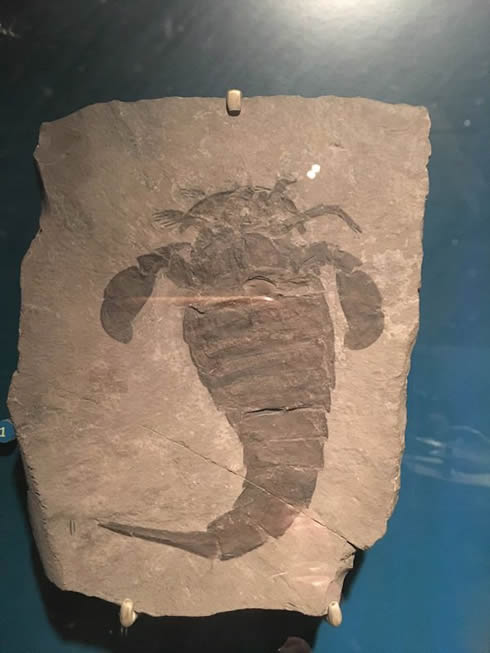
Eurypterus remipes from the Silurian of Buffalo, NY. Fossil is displayed at Chicago's Field Museum
References
https://statesymbolsusa.org/states/united-states/new-york
Geology of New Yorks's National Parks
Through Pictures
(at least the one's I have been to)
Statue of Liberty National Monument (2022)
National Parks visited but I have no pictures (at this time) to do a geology post
(link directs to NPS site)
Eleanor Roosevelt National Historic Site (2002)
Fire Island National Seashore (1998, 2002, and 2005)
Fort Stanwix National Monument (2002)
General Grant National Memorial (2003)
Home of Franklin D. Roosevelt National Historic Site (2002)
Martin Van Buren National Historic Site (2003)
Sagamore Hill Narional Historic Site (1997, 2003)
Saratoga National Historic Park (2002)
Theodore Roosevelt Inaugural National Historic Site (2002)
Upper Delaware Scenic & Recreational River (1993)
Vanderbilt Mansion National Historic Site (2002)
Women's Rights National Historical Park (2002)
Statue of Liberty National Monument
Visited in 2022
.jpg)
Obligatory entrance sign
.jpg)
The Statue of Liberty sits on Liberty Island within the Upper New York Bay near the confluence of the Hudson River and the East River. There are actually numerous geological features for the Statue of Liberty as well as Liberty Island itself. Starting from the ground up, let us look Liberty Island itself.
.png)
Bedrock Geology Map of Liberty and Ellis Islands (Volkert, 2016).
The bedrock of Liberty Island is made up entirely of what is labeled as OCh on the Geological Map above. This is the Middle Cambrian to Middle Ordovician age (~510 to 460 million years old) Hartland Formation (per the map key). The Hartland Formation is one of the two primary metamorphic rocks that make up the basement rocks of NYC. It underlies most of the western part and southern half of Manhattan and the eastern Bronx, as well as the islands within the New York Bay and into parts of New Jersey.
.jpg)
The Hartland Formation was originally a sedimentary rock that was deposited in the deep ocean, in an area surrounded by volcanoes. These volcanoes would occasionally introduce volcanic sediment into the basin mixed with other sources of sediment that added sand and clay. These sediments were then metamorphosed when North America ran into some off shore volcanic islands. This collision initiated the formation of the Appalachian Mountains, a period of time known as the Taconic Orogeny.
.png)
Surficial Geology Map of Liberty and Ellis Islands (Stanford, 1995)
On top of the bedrock sits what is known as surficial deposits. Many areas of New York, like notably Long Island, have large amounts of glacial debris sitting on top of the bedrock. Liberty Island, however, does not appear to have glacial debris. On the Surficial Geology map above, the surficial deposits are labeled as Qbn, which represents Deltaic Deposits. These are sediments that are deposited at the end of a river system, which is a mixture of rocks from further up river. These likely are related to being located at the headwaters of the Hudson and East Rivers.
.jpg)
Moving upwards from Liberty Island, we can take a look at the Statue of Liberty herself, or more specifically, the pedestal for the statues. The pedestal for the statue is largely made up of concrete, as it would need to support the weight of the statue. However, there is a granitic facade meant to "pretty up" the statue.
.jpg)
When you look downwards on the statue though, you can see that the lower base is arrayed in a star shape. This is because this was a pre-existing structure already on Liberty Island, a military fort known as Fort Wood. Most of the fort was converted and filled with concrete in order to support the statue. You can see remnants of the forts in various places across the lower foundation.
.jpg)
After the foundation was constructed within the fort, and then built up to form the pedestal for the statue, the concrete surface was then adorned with this lovely pink granite. The pink granite stones were purchased from Beattie Quarry (also known as the Leete Island Quarry) in Guilford, Connecticut, which was owned and operated by Scottish immigrant John Beattie. Stones from this quarry were used on other monuments and buildings such as Grant's Tomb (another National Park), the George Washington Bridge in New York City, the Battle Monument at West Point, and the museum buildings of the Smithsonian Institution in DC.
.jpg)
The name of this granite goes by a few names including the Leete Island Granite, Stony Creek Granite, and Stony Creek Gneiss, but geologically it seems that Stony Creek Granite is the primary name. The area where this granite is found in Connecticut has several different types of granite deposits that all flow into one another. These are dependent on the source rock and the degree of metamorphism which altered some of the granites into the metamorphic rock gneiss. The Stony Creek Granite can be described as a pink granite with medium to very coarsely grained, comprised of the minerals oligoclase, K-feldspar, and quartz with minor biotite, magnetite, garnet, and muscovite. The Stony Creek Granite formed roughly 600 million years ago, during the Proterozoic during another mountain building event known as the Avalonian Orogeny. The Avalonian Orogeny formed the Avalon Platform of Newfoundland, however effects of that mountain building event extended down into New England. During this time there was lots of magma that rose up towards the surface and cooled slowly underneath the ground to form the core granitic bodies. Over time these granites were partially metamorphosed to create the patches of gneisses.
.jpg)
Moving our way upwards, we get to the Statue of Liberty herself, focusing on the geology of her copper coating. The Statue of Liberty contains 176,000 pounds of copper that is hammered out to a thickness of 3/32 of an inch, which is the thickness of 2 copper pennies placed together. It is generally thought that the source of the copper is from the copper mines of Visnes at Karmoy, a small rocky island near Stavanger in Norway. These mines were owned by France at the time of the statue's construction, however that alone wasn't evidence enough to link the two. That is when a metallurgical analysis of the copper by Bell Labs confirmed that the impurities within the Statue of Liberty's copper matched those in the Visnes mines, indicating a likely match.
.jpg)
Looking up the stairs towards the crown, off limits when we were there.
The rock unit the copper came from is known as the Karmøy ophiolite, an Early Ordovician (~480 million years old) rock that formed as part of the sub-floor of the ocean. An ophiolite is a geological term for part of the oceanic crust that is brought up onto land. Part of this ophiolite complex contains what is known as the Visnes massive Fc-Cu-Zn sulfide deposit, where the copper used in the Statue of Liberty was found. This copper deposit was formed when basaltic rocks in the sub-sea floor were altered by the presence of magma-influenced hydrothermal fluids. This is the way a lot of copper deposits are formed, when you have a magma body heating up the ground waters and enriching them with metallic and other elements common in magmatic bodies but not common in sedimentary environments.
.jpg)
The final geological process is more of a chemical process, and that is the conversion of the copper colored copper to the green that we know the Statue of Liberty to be. While this is mostly a chemistry aspect, we can address it here as well. The answer is oxidation, also known as rust, however in copper the process is also known as patination. The oxidation process where iron is turned red by the addition of oxygen to form rust is a similar process for copper. The copper molecules combine with the oxygen to form a green patina crust to the copper plating. When originally constructed, the statue was actually the copper color of a new penny.
References
https://www.nps.gov/stli/index.htm
https://ngmdb.usgs.gov/Prodesc/proddesc_104491.htm
https://ngmdb.usgs.gov/Prodesc/proddesc_46402.htm
https://commons.library.stonybrook.edu/long-island-geologists-abstracts/395
https://www.wonders-of-the-world.net/Statue-of-Liberty/Origin-of-basement-rocks.php
https://todayincthistory.com/2020/08/05/august-5-the-statue-of-libertys-connecticut-cornerstone-2/
https://pubs.usgs.gov/bul/0484/report.pdf
https://citylore.org/sound-stony-creek-quarry-the-source-of-new-york-city-granite/
https://outerisland.org/index.php?id=geology
https://scholars.unh.edu/cgi/viewcontent.cgi?article=1367&context=neigc_trips
https://www.sciencedirect.com/science/article/abs/pii/0040195183901919
https://www.wonders-of-the-world.net/Statue-of-Liberty/Copper-of-the-statue-of-Liberty.php
https://www.norwegiansocietyoftexas.org/content.aspx?page_id=5&club_id=550176&item_id=48260
https://memorial.scholaris.ca/bitstreams/4b7dde1a-3d34-4052-bddc-d844735a0397/download
https://www.nps.gov/stli/learn/historyculture/statue-statistics.htm